I left the house before dawn and drove through a dark rain. There were no mountains to be silhouetted against the sky as I crossed the Hood Canal over to the Olympic Peninsula. I drove with high beams on down winding roads cloaked in tall evergreens before reaching the hazy sight of the inland sea and continued south. I arrived at my destination a half hour before the first glint of sunlight and wadered up in the dark.
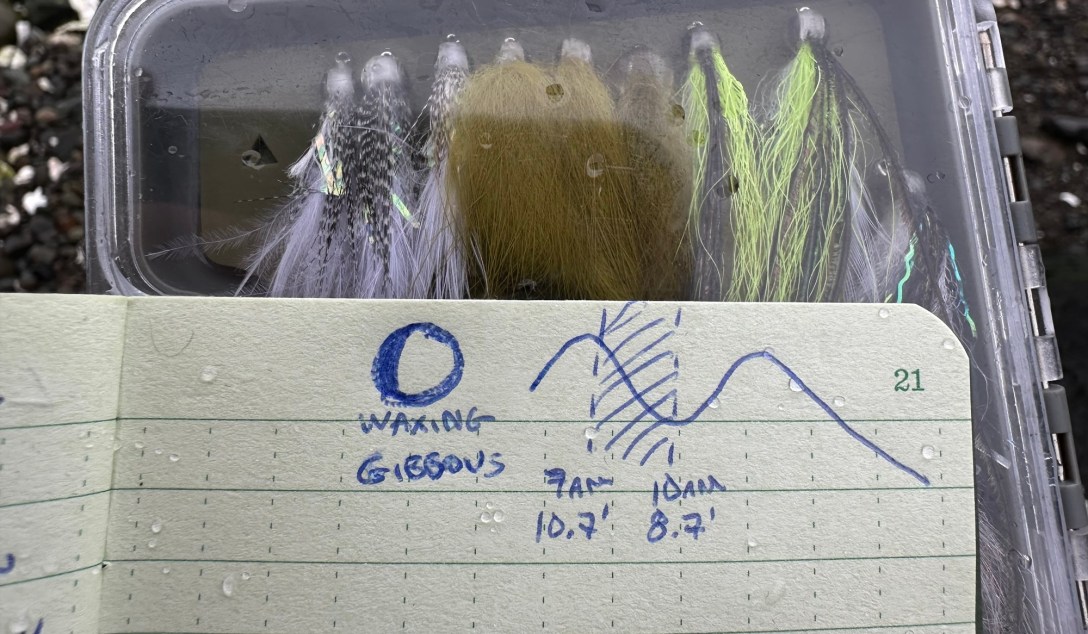
While eating breakfast earlier that morning, I watched Puget Sound fly fishing legend Dave McCoy’s weekly fishing update. He introduced me to a new term, a molar tide. That is, a truncated morning ebb and flood tidal sequence followed by a long sustained drop through the late afternoon and evening. The tide chart roughly represents a molar and it means that windows of prime tidal movement will be short during the winter hours of sunlight. The report made me second guess my plans for a brief moment, but I was already up and commited to give it a go for a couple of hours. I hadn’t been to this particular beach since last October and knew that it can be productive on an ebb tide.
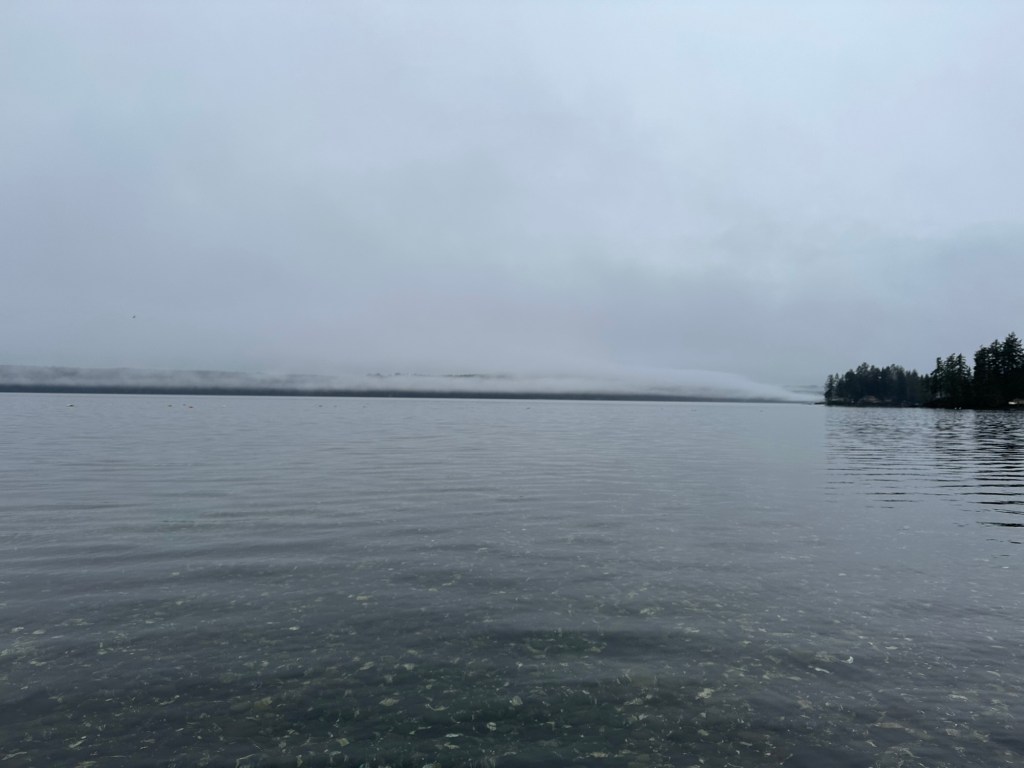
All was calm on the beach that morning; no wind and a layer of fog obscured the full height of the trees at the far shoreline. A group of a dozen or so buffleheads milled gently in the waters of the quiet estuary, every now and then diving for small crustaceans. A mother led a group of juveniles into the shallows where they splashed along an oyster bed in inch deep water.
During the winter months, I almost exclusively fish the Sound with shrimp patterns. There’s a gold mine of beautiful and creative shrimp flies developed by Scandinavian fly tyers for their local sea run brown trout fishery. These all work just as well for sea run cutthroat trout in the PNW. The pattern that I fished most regularly since October, is a combination of elements from multiple different patterns that I spun into my own. I named it the Freeze Dried Shrimp due to its use of a material called ice dubbing. I tie them both weighted and unweighted to account for varying tide depths. I fish them with a slow and steady retrieve, every now and then throwing in a slight twitch.
The first hour or so was devoid of action, save for the ducks. I methodically worked my way down the beach, attempting to leave no margin of water untouched. Suddenly, an unmistakable tug shocks a drifting mind into the present again. It’s a small cutthroat, but the skunk is off. Sometimes an early morning, a long drive, all feel justified with the netting of a single fish.
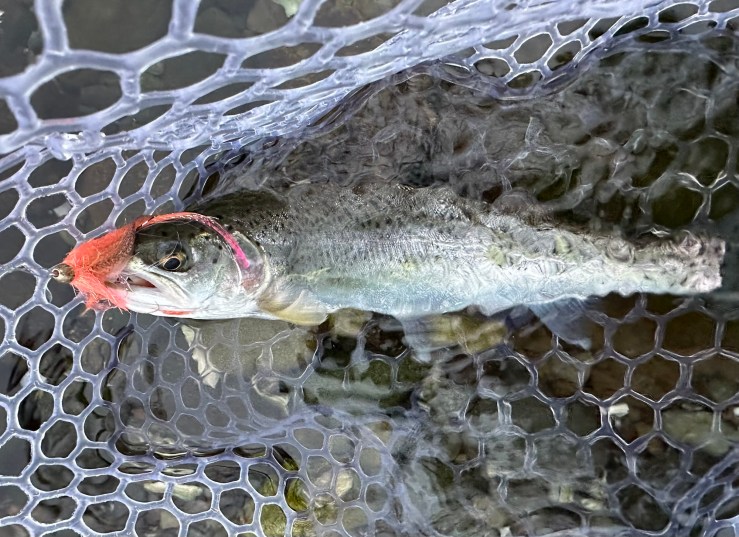
The sky began to brighten and with it came sporadic swirls along the beach; cutthroat feeding on prey near the surface. Akin to the sight of a surfacing trout on a small stream, there’s an aspect of this visual that hardlines adrenaline to the fly angler. Simply put, we live for this style of sight fishing to a feeding fish. Drop your fly into the swirl, count down a couple of seconds, give it a twitch or two, and come tight to a head shaking trout. There’s nothing quite like it.
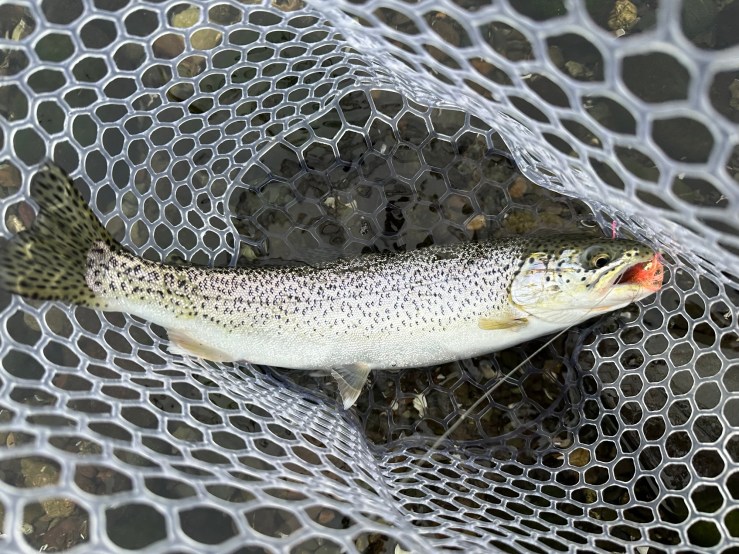
With the tide continuing to drop, I began striking the oyster bed and needed to sub out my weighted Freeze Dried Shrimp for something lighter. I thought back to that Dave McCoy report, where he recommended olive baitfish patterns. I opened my box and plucked a small three-spined stickleback imitation out. I had tied this one up in the fall with some olive rabbit strip, but only briefly fished it on a single trip. The hotspot of orange on its throat and an iridescent blood red eye filled me with a certain confidence. I’ve found that it’s good to include those kinds of details into your flies, if nothing else to convince yourself that it deserves to be fished.
I attached it with a non-slip knot and trimmed the tag end. On cue, a swirl formed straight ahead at 20ft out. I gently dropped a cast at the outer rim of the swirl. Once the fly was just close enough that I could see its movement through the water, it struck with vigor. When it jumped I could tell that this fish was not your typical cutthroat. I could make out its thick, hefty flanks as it charged by and a head that came to a slightly curved bullnose point. It took repeated runs into the oyster beds beneath it attempting to dislodge the fly, the backbone of my 6wt doing everything that it could to prevent this. It shot back out of the water with a tail walking jump, then made a hard run up the beach. I prayed audibly for my hook to hold.
When I got him into the net, I let out a yip and a long exhale. Staring back at me was the most gorgeous golden hued and leopard spotted sea run cutthroat that I’ve ever landed. A large male that, judging by his coloration, had just recently spawned in a nearby stream and returned to the salt. My personal best in both the size and beauty categories. An unblemished specimen. I was shaking as I unhooked, photographed, and released him. He swam away with a strong tail kick on his way back out to sea.
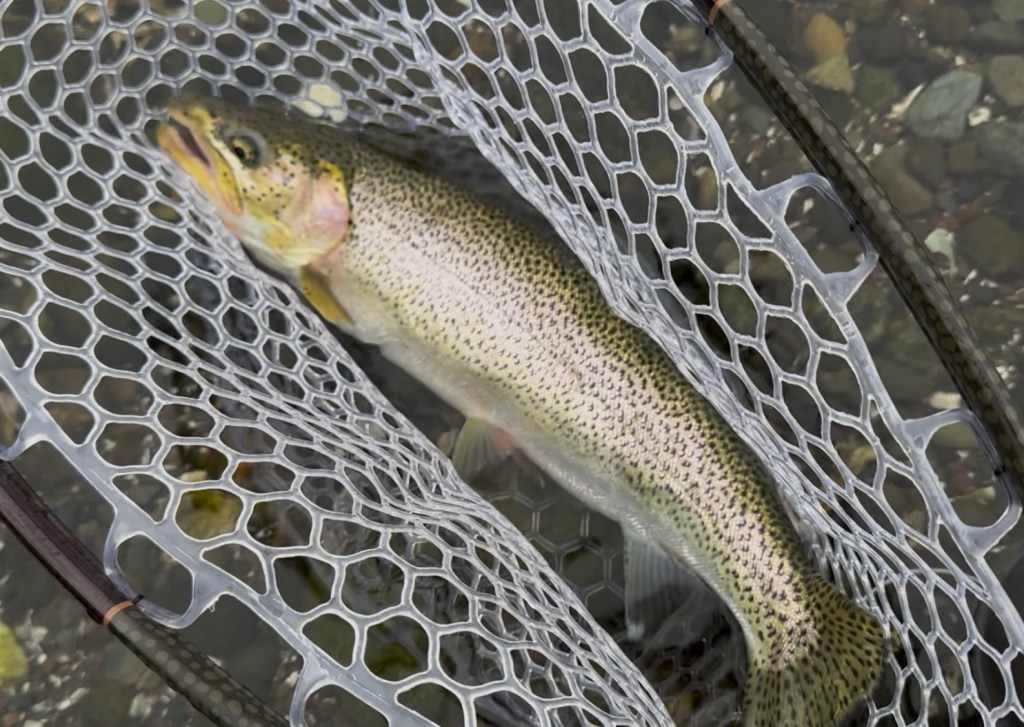
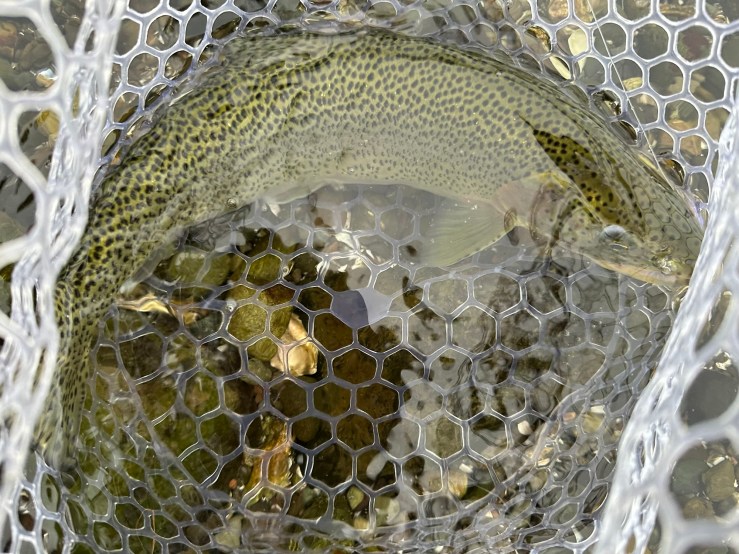
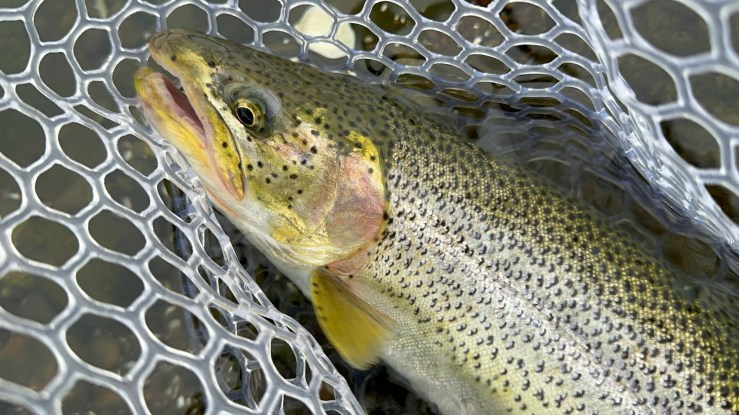
I replayed that sequence in my mind on the entire drive home. These are moments to savor. I know that it could be a long time before crossing paths with another fish like that on the Sound again.
It also dawned on me during the drive that all three of the fish on that trip struck within the last 15ft or so. As fly anglers know, the glory cast is tempting. Shooting out a long double haul feels oh so satisfying; loading the rod, generating a clean power stroke, and watching the coils of line zip through the guides. On a fishery as expansive as the Puget Sound, how could you not want to bomb one out as far as you are capable? But it made me wonder how many trout I’ve unknowingly cast over and subsequently spooked in my days. How many skunked trips could’ve been filled with memories like the ones I just experienced if I had swapped out my driver for a pitching wedge?
Moving forward, I think I’ll focus more efforts on the short to mid range casts before swinging for the fences. That and tying up a dozen or so of those stickleback flies. ASAP.
I’m taking a page from one of my favorite blogs, Cow We Doin’ by Lou Tamposi. He always ends each piece with a recipe, food in his case. These are two recipes of a different sort; the fly patterns that I mentioned earlier. The sequencing for the shrimp is a bit involved, so perhaps I’ll make a video or detailed step-by-step at some point in the future.
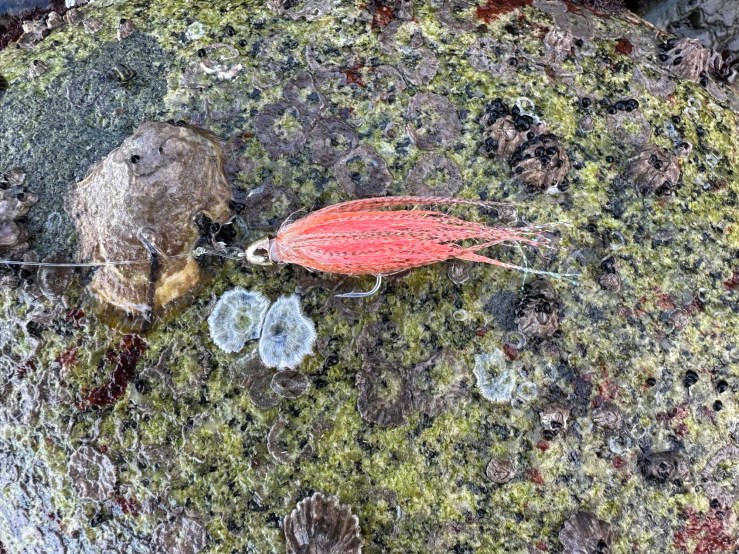
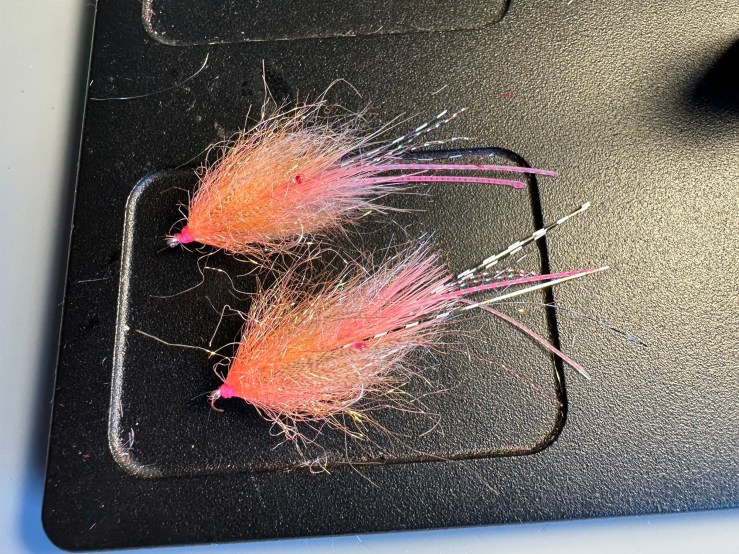
Freeze Dried Shrimp
Hook: Gamakatsu SS15 size 6
Thread: Pink
Head (weighted version): brass cone, gold, size medium
Tail: blend of shrimp pink and UV silver dun marabous
Antennae: blend of pink and pearl crystal flash
Legs: black/white barred voodoo fibers and micro barred rubber legs in pink/white
Eyes (optional): Homemade resin + mono shrimp eyes
Body: Spawn Ghost Shrimp simi seal dubbing (from back of fly to palmered mallard feather) and Fluorescent Shell Pink ice dub (directly in front of mallard feather)
Collar: Peach mallard flank (dyed in house by Waters West fly shop in Port Angeles, this is some incredibly high quality stuff)
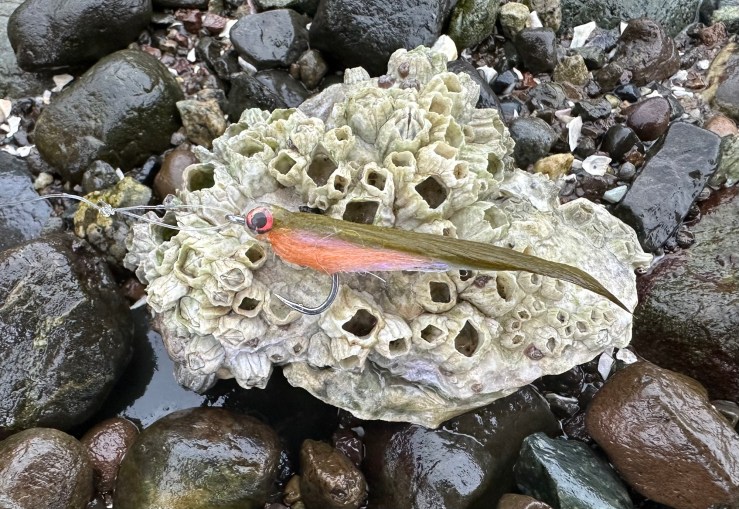
Three-Spined Stickleback
Hook: Ahrex SA280 size 6
Thread: White
Tail: White bucktail (sparse, just enough to prevent the rabbit strip from fouling around the hook)
Top side: Olive rabbit strip
Underside: UV Pearl ice dub (inner), Spawn Shrimp Orange simi seal dubbing (outer)
Eye: 4.0mm, red
Head: UV clear epoxy
Discover more from The Path Less Fly Fished
Subscribe to get the latest posts sent to your email.

 The Path Less Fly Fished