
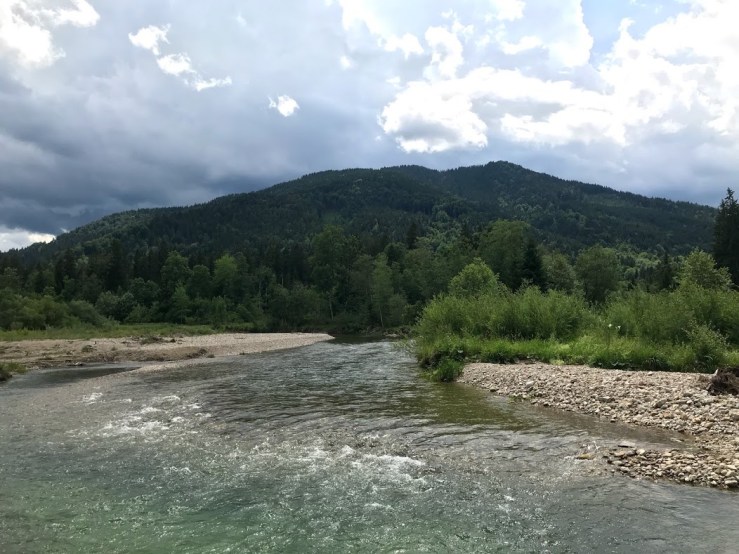
The dream of fly fishing in Bavaria began almost 3 years ago, during a trip to Germany over Christmas of 2016. There is a river there that will play a major role in this story – the Ammer river. From its source in the Ammergau Alps to its flowing into the Ammersee before eventually becoming the Amper river, it is the largest tributary of the mighty Isar. Somewhere in between it carves its way through the quiet alpine town of Oberammergau. It is here that I first experienced this special river and its trout.
A bridge in town offered the perfect vantage point. The flows were low in winter time and snow lined both banks of the river. Scanning the shoreline, my eyes stopped at a brown trout slowly finning in a quiet eddy. Wild and native trout living in the middle of this picturesque Bavarian town…these images have provided fuel for many of my day dreams in the 2 and 1/2 years since.
At the hotel that night, the first of the research began. To my amazement, there was a fly shop in Oberammergau. From my understanding it is one of, if not the only, fly shop in the entire state of Bavaria (outside of Munich). I sent off a quick email to the owner about renting some gear while in town to fish the Ammer. I had no idea what I was in for…
The email reply was a short one. “Sorry, but the trout season is closed for the winter. Come back after it opens the 15th of May.” A bit disappointing, but a nudge to start looking at the regulations if I was to seriously consider returning to fly fish someday. Things started to get interesting and my real fascination with fly fishing Germany began when I discovered the complexity that is the German fishing license. Strap in…
To this day, I am convinced that the German fishing license (or fischereischein as it’s called) is the hardest fishing license to obtain in the world. First drafted by the country in 1939 as a direct product of early-WWII era Germany, it is tethered in bureaucracy beyond reasonable logic. For citizens of Germany, the process is as follows:
- Attend 40 hours worth of classes focusing on humane fish killing techniques (catch & release is illegal), species identification, casting techniques, etc. ($$)
2. Upon finishing the course, you must receive an invitation to take a state proctored exam (more $$)
3. The exam itself is 130 questions, varying by state, and broken down in 7 or 8 different sections. A score of 75% or higher must be achieved in each section or the classes must be retaken.
The process doesn’t end at the exam, however. Successfully completing the exam shows that you possess the correct knowledge to fish, it doesn’t however allow you to legally fish there. All water in Germany is privately owned by either individuals or fishing clubs. You must gain permission from these clubs or individuals (almost always in the form of fees) to gain access. Access slots are limited and fishing a river like the Ammer required me to reserve a single day more than 6 months in advance.
Luckily for me, the path to fishing Germany legally is much easier for foreigners. After many email chains and back and forth translations, I learned that a touristenfischereischein could be acquired with a passport, fishing license issued from your country (with the expectation being that the process of obtaining it was similarly arduous), a photo and a fee.
For two years my mom and I had talked of returning to Oberammergau, the town where she spent part of her childhood. We would do it in the summer, when wildflowers were in bloom in the fields across town and cows with bells tied around their necks could be heard grazing from the mountainous pastures. The joint celebrations of graduating college and her retirement from teaching gave us the perfect occasion to make this the summer that we’d finally return. The trip was far from solely a fly fishing one, but it provided me with the opportunity to check an item off of my bucket list – a single day fly fishing the Ammer river.
This is the story of how it happened.
Discover more from The Path Less Fly Fished
Subscribe to get the latest posts sent to your email.

 The Path Less Fly Fished
